

Learning grammar is one of the most difficult things for Korean language learners. On this blog we will try to help you learn Korean grammar in the quickest and easiest way possible.
This blog will be helpful for those who are studying Korean language and want to improve their grammar skills.
Today we’ll see the usage of 만약 with some example sentences.
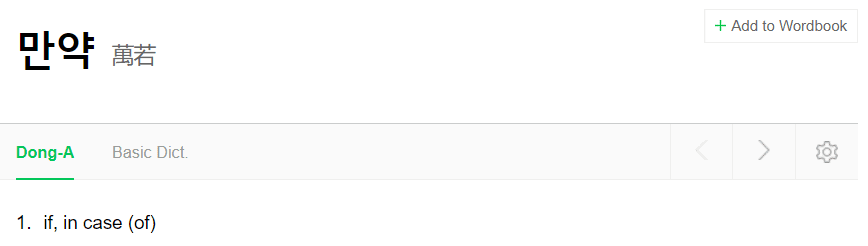
만약 is used when the speaker considers an unexpected case or situation that might happen.
It is equivalent to saying “supposing / in case” in English.
Let’s look at an example to understand its usage:
If this gets out, there will be trouble.
만약 이것이 알려지면 곤란해질 것이다.
Also check these useful Korean vocabulary resources:
1000 Most Common Korean Words – Must-Know Korean Vocabulary
200 Must-Know Korean Verbs For Rookie Learners
100 Must-Know Korean adjectives – How to conjugate and use them
Lets see some examples to understand the usage :
1) If untreated, the illness can become severe.
만약 치료를 안 받으면 병이 심해질 수 있다.
2) Can I return it if it doesn't fit?
만약 안 맞으면 바꿀 수 있나요?
3) In the event of an accident, call this number.
만약 사고가 생기면 이 번호로 전화하세요.
4) If it rains tomorrow, I'll stay home.
만약 내일 비가 온다면 집에 있을 거예요.
5) She took out life insurance just in case.
그녀는 만약에 대비해서 생명보험을 들었다.
6) I won't stand by if that happens.
만약 그런 일이 일어난다면 가만히 있지 않겠다.
7) If I can't go home, you guys should at least go on your own.
만약 내가 집에 못 가게 되면, 너희들끼리라도 가도록 해라.
To understand TOPIK Test structure, application process, Levels and Passing scores etc. check these pages:
- TOPIK – The Complete Guide & 2. TOPIK Levels and Passing Marks. You can also Practice Online with TOPIK GUIDE Mock Tests.
If you are going to take the TOPIK Test for the first time, or if you want to give your score a boost so that you can pass a higher level, we would strongly advise you to get the Complete Guide to TOPIK – Self-Study Package. It is a digital study package that has everything you need to get a great score in the TOPIK test – all the past TOPIK papers with answer sheets, grammar and vocabulary study material, video tutorials explaining the test structure, strategies to solve them and much more. You can check out more details about this study package HERE.
Learning Korean can be tricky, especially when the goal of your learning is conversation. If you’ve ever attempted to speak Korean but were unable to, then hopefully you’ll find this post helpful.
Thank you for reading. If you have any questions or suggestions. Comment down below.
