
All About TOPIK Test – The Complete Guide
Whether you are going to take the TOPIK Test for the first time, or retaking it to pass a higher level, we highly recommend Complete Guide to TOPIK – Self-Study Course to prepare for the test efficiently in a short time.
This online course prepared by our team of experts has everything you need to pass TOPIK with a high score. past TOPIK papers with answer sheets, grammar and vocabulary study material, video tutorials explaining the test structure, strategies to solve them, and much more.
TOPIK Test Schedule in 2026
TOPIK Test registration and exam dates, result announcement dates and so on.
What is TOPIK?
TOPIK, Test of Proficiency in Korean, is a written test designed to measure the ability of non-native speakers for expression and comprehension in the Korean language.
TOPIK test measures proficiency in reading, writing, and listening comprehension in the Korean language. The test has three different levels: Beginner, Intermediate and Advanced. Further accuracy is expressed through six grades, two matched to each level to evaluate proficiency.
Purpose of Exam
- To propagate and set direction for learning Korean for non-native Korean speakers and overseas Koreans.
- To measure and evaluate their Korean language skills and utilize the results for admission to Korean colleges and job-seeking
Applicant Qualification
Overseas Koreans and foreigners for whom Korean is a second language and who:
- Aim to learn the language and enter a Korea university for higher studies
- Seek jobs in companies and public institutions in Korea and overseas
- Reside overseas or are attending/graduated from a foreign school
Who administers the TOPIK Test?
National Institute for International Education (NIIED), which operates directly under the Ministry of Education, Science and Technology, is responsible for the general management of the test, such as supervising institutions administering the test in domestic and overseas locations.
For whom is the TOPIK intended?
This comprehensive test is intended for non-native speakers of Korean, such as Korean language learners, international students who want to study in Korea as well as individuals who would like to work in Korean companies and public institutions.
The test also serves as an excellent opportunity to receive formal certification for those who expect to use Korean in their careers. Students of Korean who take the test will also learn which aspects of the language they need to concentrate on in future study.
How can I register for the TOPIK Test?
In Korea: If you are in Korea, you can register for the test online on www.topik.go.kr. The registration fee is KRW 35,000 for TOPIK I (level 1-2) and KRW 40,000 for TOPIK II (level 3-6), which can be paid through debit/credit card, online banking or direct bank transfer.
In Other Countries: In most countries, the Korean Embassies and Korean Culture Centres (한국문화원) administer the TOPIK tests. Some affiliate institutes also accept the applications. You can get the list of the affiliate institutions in your country our Updates page. For registration, you have to visit the embassy or affiliate institution with 2 passport size photographs and the registration fee (which varies country to country).
You can watch the video below to see the complete registration process.
Register for Next TOPIK Test
When is the test conducted?
TOPIK test is conducted held 6 times in a year – 3 times only in Korea (January, May and November) and 3 times both in Korea and overseas (April, July, and October). In most countries, the TOPIK I test is held in the morning and the TOPIK II test is held in the afternoon. So you can take both TOPIK I and II on the same day if you want to. Test is always held on Sundays (in some countries on Saturdays as well). You can check all important dates of TOPIK test in 2023 HERE.
TOPIK Test Structure
TOPIK test has two levels – TOPIK-I and TOPIK-II. TOPIK-I, i.e. the beginner level, has two sublevels – 1 & 2 while TOPIK-II, i.e. Intermediate-Advanced level, has 4 sublevels – 3, 4, 5 & 6. Test takers get a level between 1 and 6 based on their total score in the test.
Test takers who meet the requirements will be issued a formal certificate with one of six possible grades: low beginner (level 1), high beginner (level 2), low intermediate (level 3), high intermediate (level 4), low advanced (level 5), and high advanced (level 6).
Levels 1 and 2 – Beginner Level
Levels 3 and 4 – Intermediate Level
Levels 5 and 6 – Advanced Level
TOPIK-I (Level 1-2) has just two sections – Reading and Listening. TOPIK II (Level 3-6), which is the combined Intermediate-Advanced test, has 3 sections – Reading, Listening and Writing.
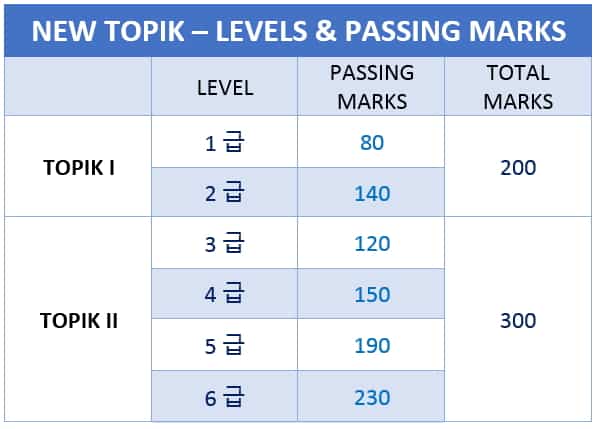
Each section is graded out of 100 points with a possible total of 200 points for the Beginner and 300 points for Intermediate-Advanced level. The test includes composition, listening and multiple choice sections.
The test consists of two 90-minute sessions with a 30-minute break in between. The first session tests vocabulary & grammar, and writing, and the second session tests listening and reading.
TOPIK Levels and Passing Score
TOPIK Levels & Language Skills Required
Following is the brief description of the language skills demanded of each level.
[Beginner level]
1st Grade Use of basic commands of Korean for survival, such as greeting, purchasing, ordering, etc. Expressing and understanding oneself in simple everyday conversation by making simple sentences from 800 basic words.
2nd Grade Discussion of familiar topics employing a vocabulary of about 1,500∼2,000 words. Distinguishing correctly between formal and informal situations.
[Intermediate level]
3rd Grade Carrying out transactions with people in public spaces and maintaining social relationships. Understanding the correct usage of words and speech. Command of fundamental characteristics of Korean.
4th Grade Comprehension of news articles, general social issues and abstract topics with accuracy and fluency. Comprehension of Korean social and cultural contents relying on essential idioms and understanding of representative aspects of Korean culture.
[Advanced Level]
5th Grade High fluency in using the Korean language in professional research or work. Understanding and discussing less unfamiliar topics in politics, economics and other fields. Usage of appropriate expressions, distinguishing formal and informal, written and spoken, by context.
6th Grade Absolutely fluent in the Korean language for professional research or work, Capacity to understand and express oneself without problem, although without the full fluency of a native speaker.
How is the exam structured?
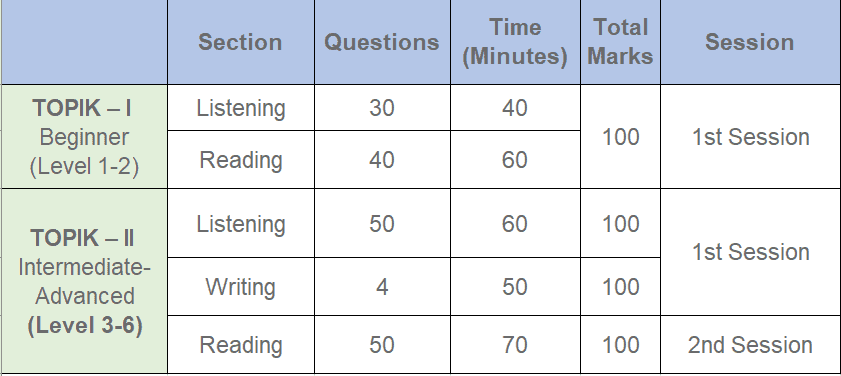
Generally the Beginner level test (TOPIK-I) is held in the morning and Intermediate-Advanced level test (TOPIK-II) in the afternoon. TOPIK-I is a 100 minutes test (40 minutes for Listening section and 60 minutes for Reading section) and will be finished in 1 session. TOPIK – II is a 3 a 3-hour exam, which is split into two sessions with a short break in between. The first session paper (110 minutes) consists of two sections: Listening and Writing and the second session paper (70 minutes) has one section – Reading.
Question Composition
TOPIK – I (Level 1-2) has a total of 70 Multiple Choice Questions – Reading (40 Questions) and Listening (30 Questions). TOPIK I has a total of 200 marks and the Test Time is 100 Minutes.
TOPIK II (Level 3-6) has a total of 104 Questions – Reading (50 Multiple Choice Questions) and listening (50 Multiple Choice Questions) and Writing (4 Short-answer/Essay Questions). TOPIK II has a total of 300 marks and the Test Time is 180 Minutes.
Writing section in Intermediate-Advanced Level: The writing section has just 4 questions. There are 2 short answer questions where you don’t have any options to choose the answer from; you have to write the phrase or sentence. Then you have two essay questions. One essay will be related to everyday life topics and will be easier to write while the other essay will be a logical one where you will have to write your opinion on some issue. The first essay will be shorter (200-300 characters) and they will provide you some content as well in the form of hints/points. The second essay will be a long one (600-700 characters).
Is there any Sample Paper to understand and practice the TOPIK Format?
Yes, you can download the Previous and Sample Test Paper from This Page. You can also practice by taking our online Mock Test.
Is there any special eligibility criteria for the exam?
No. Anyone studying Korean Language (at an institution or by self-study) can appear in the exam.
What is the validity period of TOPIK score?
TOPIK score or certificate is valid for 2 years.
Are there any good guide books to prepare for TOPIK?
If you are going to take the TOPIK Test for the first time, or if you want to give your score a boost so that you can pass a higher level, we would strongly advise you to get the Complete Guide to TOPIK – Self-Study Package. It is a digital study package that has everything you need to get a great score in the TOPIK test – all the past TOPIK papers with answer sheets, grammar and vocabulary study material, video tutorials explaining the test structure, strategies to solve them and much more. You can check out more details about this study package HERE.
Test Result Announcements
– Test results are announced at the TOPIK website (www.topik.go.kr) and individual score reports are sent to all test takers regardless of pass or fail.
– When checking through the website, you must know the test number (e.g. if you took the 40th test, 40); application number and birth date.
– Level applied, area-specific score, total score, average score, and pass or fail are declared on score report
Score report shipping
Score reports are sent out through individual mail to test takers in Korea.
For people who appeared in the test overseas, all score reports are sent to the affiliated institution of that nation, who will be responsible for distributing to each test taker.
Those who took the test overseas can also confirm their score on the website (www.topik.go.kr).
Printing the Score Report
– For the purpose of submitting score reports to institutions such as colleges or companies, score reports can be printed out on the website print page any time after paying a minimal fee.
Who should I contact if I have any query?
(☎ 02-3668-1331 or e-mail: topik@korea.kr) or you can ask TOPIK GUIDE (admin@topikguide.com).
**For more information on the TOPIK test you can visit the official site https://www.topik.go.kr or email us on admin@topikguide.com.
Take TOPIK Mock Tests Online
Assess your level by taking TOPIK Mock Tests online stimulating real test environment.