
Stop Guessing How Korean Words Sound - Use this Korean Pronunciation Checker Tool
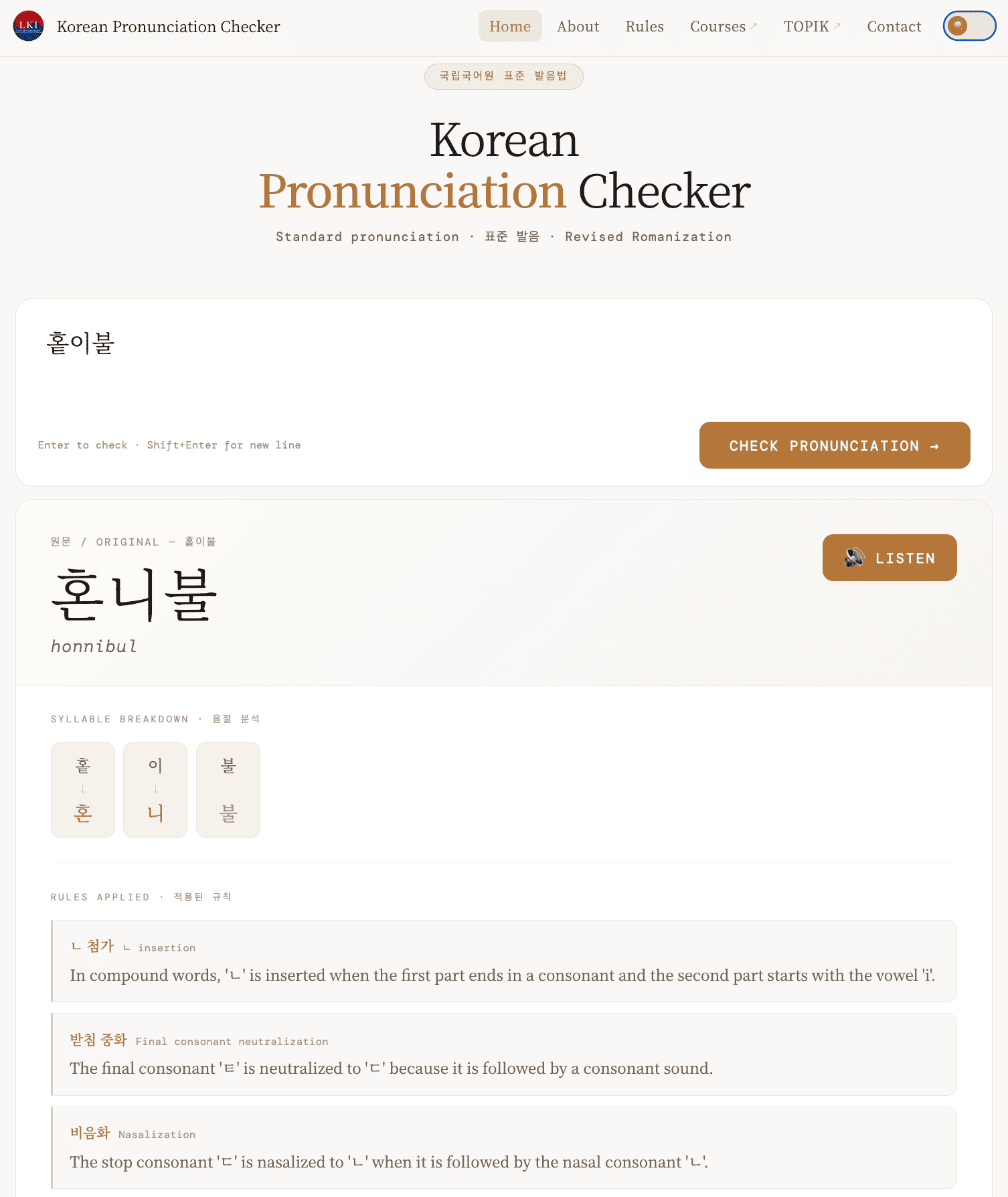
If you've ever stared at a Korean word and wondered, "Wait, is that actually how it sounds?" — you're not alone. Korean pronunciation rules are notoriously tricky, full of silent letters, consonant assimilation, and sounds that shift depending on what comes before or after them. Now, LKI School of Korean Language has built a free, instant solution: the Korean Pronunciation Checker at koreanpronunciation.com.
Whether you're a self-study learner prepping for TOPIK, a classroom student struggling with tricky vocabulary, or even an advanced speaker who wants to double-check a formal word before a presentation — this tool was built for you. In this post, we'll walk through what it does, why Korean pronunciation is so challenging in the first place, and how to make the most of this incredible free resource.
Why Korean Pronunciation Is Harder Than It Looks
At first glance, Hangeul (한글) seems refreshingly logical. Unlike Chinese characters or Japanese kanji, Korean letters map fairly directly to sounds. New learners often feel a rush of confidence after mastering the alphabet in just a few days. Then they try to pronounce real Korean words — and the confidence evaporates.
Here's the problem: written Korean and spoken Korean are not the same thing. Korean has a well-defined set of phonological rules that determine how words actually sound when spoken aloud, and those rules often make the spoken form look completely different from what's written on the page.
The National Institute of Korean Language (국립국어원) maintains the official standard pronunciation rules — 표준 발음법 — a set of guidelines governing exactly how every Korean word should be pronounced in formal, standard Korean. These rules cover everything from consonant clusters to vowel contractions. There are dozens of them. Even native Koreans sometimes get tripped up on the finer points.
For learners, the most frustrating part is applying these rules in real time to an unfamiliar word in the middle of a study session. Here are some examples of how dramatically a word's pronunciation can differ from its written form:
Memorising all of these rules is a significant undertaking — and that's exactly the gap that the Korean Pronunciation Checker fills.
Introducing the Korean Pronunciation Checker by LKI
Developed by LKI School of Korean Language and created by Dr. Satish Satyarthi — a PhD holder in Korean language and founder of the globally trusted TOPIK Guide platform — the Korean Pronunciation Checker at koreanpronunciation.com is a free, web-based tool that tells you exactly how any Korean word should be pronounced, based on the official 표준 발음법 of the 국립국어원.
What Makes This Tool Unique
Unlike generic text-to-speech tools or simple romanization converters, the Korean Pronunciation Checker doesn't just read letters out loud — it applies the actual phonological rules of standard Korean and shows you phonetic Hangeul, Revised Romanization, and an explanation of which rule applies and why. It's a pronunciation tutor, not just a converter.
LKI School of Korean Language has been helping learners worldwide since 2009 through TOPIK Guide and its flagship language institute. More than 50 students from LKI have gone on to receive the prestigious GKS (Government of Korea Scholarship) to study in Korea. This tool is a natural extension of that educational mission — making high-quality, academically rigorous Korean learning resources freely available to everyone.
Key Features of koreanpronunciation.com
Instant Results
Type or paste any Korean word and get the correct pronunciation in seconds. No sign-up, no paywall, no delay.
Phonetic Hangeul Output
See how the word actually sounds written in Hangeul — not how it's spelled, but how it's pronounced.
Revised Romanization
Get the Revised Romanization of Pronunciation so you can confirm the sounds even if you're still building Hangeul confidence.
Rule Explanation
The tool tells you which pronunciation rule transformed the word. You learn, not just copy.
Based on 국립국어원 Standards
Grounded in the official Standard Pronunciation Rules of the National Institute of Korean Language. Academic-grade accuracy.
Works on Any Device
Mobile-friendly and accessible from any browser — use it on your phone while studying, no app download needed.
How to Use the Korean Pronunciation Checker
Using the tool couldn't be simpler. Here's how to get the most out of it in four easy steps:
Step 1 — Visit the Tool
Go to koreanpronunciation.com on any device. No account or registration is needed.
Step 2 — Enter a Korean Word
Type the Korean word you want to check in the input field. You can type it using a Korean keyboard, or simply paste it from your textbook, flashcard app, or TOPIK practice paper.
Step 3 — Get Your Pronunciation
The tool instantly shows you the phonetic Hangeul form of the word (how it actually sounds when spoken), the Revised Romanization, and a clear note on which pronunciation rule has been applied. This is where real learning happens — you don't just see an answer, you understand the reason behind it.
Step 4 — Practice and Move On
Use the phonetic output to practice saying the word correctly. If you're using it alongside a vocabulary list or TOPIK study session, you can check words one by one without breaking your study flow.
"The most powerful moment in language learning is not memorising a rule — it's seeing that rule at work in a real word you actually needed to use."— The principle behind the Korean Pronunciation Checker
The Most Useful Pronunciation Rules the Tool Covers
To give you a sense of the depth this tool handles, here are some of the most important — and most frequently misapplied — Korean pronunciation rules that the checker addresses:
| Rule Name | Written | Spoken | What Happens |
|---|---|---|---|
| Liaison (연음) | 음악 | [으막] | Final consonant moves to the next syllable's initial position |
| Nasalisation (비음화) | 작년 | [장년] | Stop consonants become nasal before nasal consonants |
| Aspiration (격음화) | 좋다 | [조타] | Plain consonant + ㅎ merges into an aspirated consonant |
| Tensification (경음화) | 학교 | [학꾜] | Plain consonants become tense after certain environments |
| Lateralisation (유음화) | 진리 | [질리] | ㄴ becomes ㄹ when adjacent to ㄹ |
| Cluster Simplification (자음군 단순화) | 닭 | [닥] | Double consonant clusters reduce to one in final position |
| ㄹ Nasalisation | 심리 | [심니] | ㄹ becomes ㄴ after certain nasal consonants |
| Palatalisation (구개음화) | 굳이 | [구지] | ㄷ/ㅌ before 이 becomes ㅈ/ㅊ |
This is only a sample — the full set of Korean Standard Pronunciation Rules runs to many more cases and exceptions. The tool handles all of them so you don't have to memorise every scenario from scratch.
Why This Tool Is a Game-Changer for TOPIK Preparation
If you're studying for the TOPIK exam, pronunciation might seem like a separate concern — after all, TOPIK is a written test, not a speaking exam. But correct pronunciation knowledge actually supports your performance in several important ways.
Listening Comprehension (듣기) Becomes Easier
The TOPIK listening section features native Korean speakers using natural pronunciation. If you've been reading words in their written form and mispronouncing them in your head, you may not recognise those same words when spoken aloud. Knowing the actual phonetic form of vocabulary helps your brain make the connection between written and spoken Korean much faster.
Vocabulary Retention Improves
Research in language acquisition consistently shows that words are remembered more reliably when learners encode them with correct phonological information. When you study 입학 and know it sounds like [이팍] — not [입학] — you're creating a more complete mental representation of the word that's harder to forget.
Reading Speed Increases
Fluent readers subvocalise as they read — they process words through their phonological memory, even silently. If your internal "voice" is mispronouncing Korean words, it creates a subtle cognitive load that slows your reading. Correct pronunciation knowledge smooths this out.
💡 Study Tip: Combine Vocabulary Lists with the Pronunciation Checker
When building your TOPIK vocabulary list, make it a habit to check each new word in the Korean Pronunciation Checker. Add the phonetic Hangeul form to your flashcard alongside the written form. Within a few weeks, you'll notice dramatically faster recognition during listening practice.
Who Is This Tool Best Suited For?
The Korean Pronunciation Checker is genuinely useful across every stage of learning:
Absolute Beginners
If you've just learned Hangeul and are starting to read your first Korean words, you're at exactly the right stage to use this tool. Building correct pronunciation habits from day one is far easier than correcting bad habits later. Use it with every new word you encounter.
Intermediate Learners (TOPIK I & II)
At this stage, you're encountering vocabulary with increasingly complex phonological environments — compound words, words with double consonant endings, words where particles trigger changes. The checker becomes a powerful self-correction tool for your growing vocabulary.
Advanced Learners and TOPIK Level 5–6 Candidates
Advanced learners often encounter formal, academic, or technical vocabulary — words that even native Korean speakers may pause to think about. The tool's grounding in official 국립국어원 standards makes it the most reliable reference for formal pronunciation at this level.
Teachers of Korean
Whether you're a Korean teacher, tutor, or content creator, the tool is an invaluable classroom reference. Quickly verify pronunciation before a lesson, generate examples for teaching specific rules, or have students use it as a self-check activity.
About LKI School of Korean Language
LKI (Learn Korean India) School of Korean Language is India's leading Korean language institute, founded by Dr. Satish Satyarthi — a GKS Scholar from Seoul National University and a PhD holder in Korean language. LKI has been helping learners worldwide since 2009 through both its institute and the globally trusted TOPIK Guide website (topikguide.com).
LKI's approach is rooted in academic rigour paired with genuine accessibility. The institute offers small-batch classes taught by both Indian and native Korean instructors, comprehensive TOPIK preparation, and ongoing career mentoring for students pursuing scholarships and Korean language careers. More than 50 LKI students have received the prestigious GKS scholarship to study in Korea.
The Korean Pronunciation Checker is a perfect expression of LKI's broader mission: to make high-quality Korean language education freely available to learners everywhere, regardless of where they live or what resources they have access to.
Try the Korean Pronunciation Checker — It's Free
Check the standard pronunciation of any Korean word instantly. Based on official 국립국어원 rules. No sign-up required.
Go to koreanpronunciation.com →Final Thoughts
Pronunciation is one of the most under-resourced areas of Korean language learning. Grammar books cover rules in theory. Dictionaries give you definitions. Audio files give you a native speaker's version. But none of these tell you why a word sounds the way it does — in a way that's immediate, searchable, and educationally grounded.
That's what makes the Korean Pronunciation Checker at koreanpronunciation.com genuinely different. It's not just a tool — it's a teaching moment delivered at the exact instant you need it. Built on official standards by one of the most respected Korean language educators in the world, and offered completely free of charge, it deserves a permanent spot in every Korean learner's study toolkit.
Bookmark it today. The next time you're studying and you hit a word that makes you say "Wait, how do I actually say this?" — you'll know exactly where to go.

follow us: